Active Learning Classrooms
by Derek Bruff, adapted from a 2018 Agile Learning blog post
Active learning classrooms (ALCs) were identified as a top strategic technology in EDUCAUSE’s 2017 survey of higher education information technology leaders. It was the first time ALCs made the top ten, and they entered the list at #1. This teaching guide provides a brief introduction to research on ALCs. For a more comprehensive literature review, see A Guide to Teaching in the Active Learning Classroom: History, Research, and Practice (Stylus, 2016).
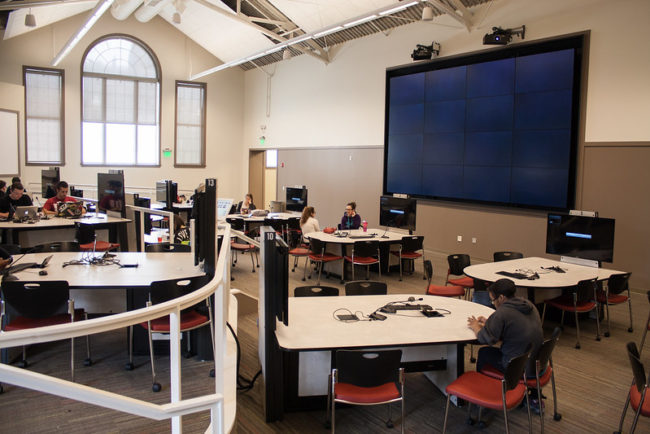
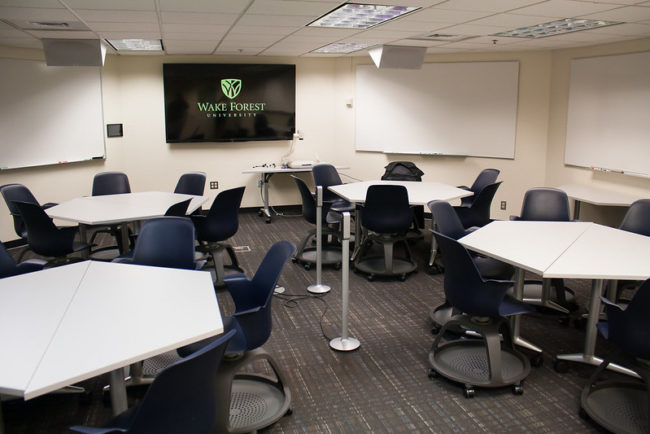
What is an active learning classroom? ALCs feature “round or curved tables with moveable seating that allow students to face each other and thus support small-group work. The tables are often paired with their own whiteboards for brainstorming and diagramming” (Baepler, et al., 2016). Some ALCs also feature multiple displays, allowing instructors and students to project their laptops around the room, and some include microphones for sound projection. Wifi and power is critical for student laptops and smart phones. Note that ALCs are more or less flexible depending on the kind of furniture used. The Mosaic classroom at Indiana University (above) has fixed tables, while the computer science classroom at Wake Forest University (below) features small, movable tables.
Why are active learning classrooms useful? In the STEM disciplines (science, technology, engineering, mathematics), active learning instruction, defined as practice that “engages students in the process of learning through activities and/or discussion in class, as opposed to passively listening to an expert,” is known to be more effective than traditional lecturing for student learning and student success (Freeman et al., 2014). The research is clear: If your instruction involves “continuous exposition by the teacher,” there’s a better way to teach. That’s true in the STEM disciplines, and it’s likely true in other fields, too, although there’s not as much research on active learning in, say, the humanities. Active learning classrooms are useful, then, because research shows that the affordances of ALCs facilitate adoption of active learning instruction, which leads to greater student learning (Whiteside, Brooks, & Walker, 2010; Baepler, Walker, & Driessen, 2014).
Consider the Whiteside study, which involved formal class observation of a biology faculty member teaching in an ALC and in a traditional classroom. The researchers found that, “despite the professor’s explicit attempts to conduct the same learning activities in both sections, he behaved quite differently in the two classrooms, lecturing significantly more in the traditional room and conducting discussion significantly more in the ALC… The instructor also consulted (discreetly) with individual or small groups of students significantly more in the ALC than in the traditional classroom” (Whiteside et al., 2010). For instructors interested in practicing active learning instruction, an active learning classroom makes it easier to do so than a classroom set up for lecturing. Space matters.
What makes active learning classrooms work? As useful as the audio-visual technology in an ALC is, some research points to the tables and whiteboards as the most important ingredients in an ALC (Stoltzfus & Libarkin, 2016; Park & Choi, 2014). Soneral and Wyse (2017) compared student performance on concept inventories across two sections of an introductory biology course taught by the same instructor in two different classrooms. One “high tech” classroom had the full ALC set-up, with screens at every table for projection by students or the instructor. The other “low tech” classroom had the tables and whiteboards, but no screens. The study found no difference in student outcomes between the high-tech and low-tech ALCs. In his Leading Lines podcast interview, ALC researcher D. Christopher Brooks mentioned survey research that corroborates this finding: “What [students and faculty] thought was the most important technology in space were the round tables, because it created a situation that was conducive to them to interact with one another, to talk… Survey after survey, each semester, each semester students were telling us this.”
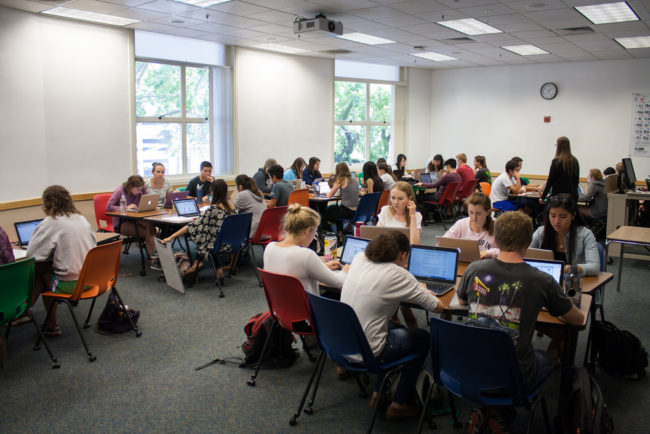
This is good news for institutions who want more active learning classrooms, but can’t afford the high-end tech in all of them. Building out flat classrooms with good tables, moveable chairs, and lots of whiteboards is a great way to support active learning instruction. Cornelia Lang, associate professor of astronomy at the University of Iowa, teaches regularly in active learning classrooms, and she describes in detail her teaching practices in those spaces in her Leading Lines podcast interview. She also noted that her colleagues in physics and astronomy have figured out what Soneral and Wyse did, that it’s the tables and whiteboards that really enable active learning instruction. Her department is moving to a low-tech ALC model for most of their classrooms as they have the chance to renovate their classrooms.
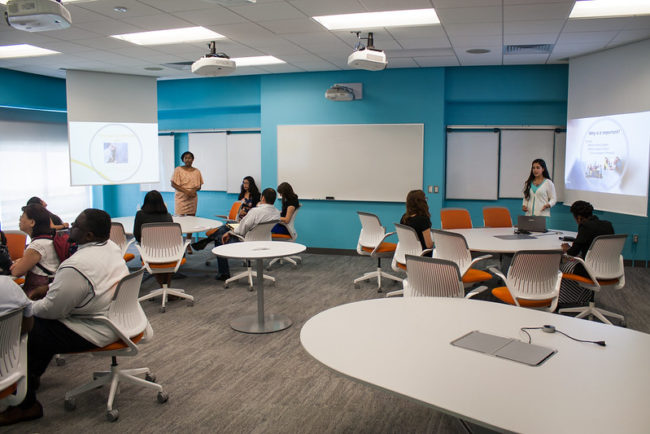
Note that faculty development is often critical to the success of an ALC initiative (Morrone, et al., 2017). Many ALC initiatives, including those at University of Iowa and Indiana University include professional development provided by a teaching center. This is why D. Christopher Brooks and colleagues wrote their book: “Sometimes, it’s overwhelming enough just developing an active learning exercise to work on with students in order to achieve your objectives… This is part of why we wrote the book, to help folks figure out the kinds of things that they can do, the kinds of barriers they’ll going to find in those spaces and to think through how teaching in this space is different than teaching in a traditional classroom.”
The photos of ALCs in this guide were taken by CFT director Derek Bruff. For more photos of ALCs and other learning spaces, see Bruff’s Flickr album. Join FLEXspace for even more photos and documentation of ALCs.
References
Baepler, P., Walker, J., Brooks, D., Saichaie, K., & Petersen, C. (2016). A guide to teaching in active learning classrooms: History, research, and practice. Stylus.
Baepler, P., Walker, J., & Driessen, M. (2014). It’s not about seat time: Blending, flipping, and efficiency in active learning classrooms. Computers & Education, 78, 227-236.
Freeman, S., Eddy, S., McDonough, M., Smith, M., Okoroafor, N., Jordt, H., & Wenderoth, M. (2014). Active learning increases student performance in science, engineering, and mathematics. Proceedings of the National Academy of Science, 111(23), 8410-8415.
Morrone, A., Flaming, A., Birdwell, T., Russell, J., Roman, T., & Jesse, M. (2017, December 4). Creating active learning classrooms is not enough: Lessons from two case studies. EDUCAUSE Review.
Park, E. L., & Choi, B. K. (2014). Transformation of classroom spaces: traditional versus active learning classroom in colleges. Higher Education, 68(5), 749–771.
Soneral, P. &, Wyse, S. (2017). A SCALE-UP mock-up: Comparison of student learning gains in high- and low-tech active-learning environments. CBE—Life Sciences Education, 16(1).
Stoltzfus, J., & Libarkin, J. (2016). Does the room matter? Active learning in traditional and enhanced lecture spaces. CBE—Life Sciences Education, 15(4).
Whiteside, A., Brooks, D., Walker, J. (2010). Making the case for space: Three years of empirical research on learning environments. EDUCAUSE Quarterly, 33.

This teaching guide is licensed under a Creative Commons Attribution-NonCommercial 4.0 International License.